Together We Deliver
From efficient aircraft turnarounds to assured underslung rigging standards and disciplined ground-to-air communication, every element of the Joint Helicopter Support Squadron’s (JHSS) activities is focused on keeping military aviation lift moving safely, precisely and effectively. Stewart Marshall joined the Squadron on a recent Exercise to learn about the professional team operating quietly at the centre of helicopter operations.
Introduction
The Joint Helicopter Support Squadron (JHSS) is a specialist joint unit of the British Army’s Royal Logistic Corps, Army Air Corps and the Royal Air Force (RAF), based at RAF Benson under the Joint Aviation Command. Originally formed in 1982 during the Falklands conflict as the Joint Helicopter Support Unit (JHSU), it was created to provide rapid, flexible, and specialist logistics and ground support for helicopter operations in combat. In 2009, following its merger with the RAF’s Mobile Air Operations Team (MAOT), the unit was redesignated as the Joint Helicopter Support Squadron.
The Squadron comprises approximately 110 personnel, with around 60 per cent drawn from the British Army—primarily the Royal Logistic Corps—and 40 per cent from the RAF. The RAF element largely consists of Logistics Movements personnel (“Movers”) from 1 Air Mobility Wing.
Operating at high readiness, JHSS establishes and manages landing points and tactical helicopter parks in austere environments, allowing rotary-wing aircraft to operate far from established infrastructure. Central to this role is the preparation, rigging and movement of equipment, vehicles and stores by underslung load. By delivering safe, efficient hook-up operations and maintaining effective ground control, JHSS ensures aircraft can rapidly reposition vital supplies and equipment across the battlespace, providing commanders with the mobility and flexibility required to sustain operations wherever they are needed.
The Team
JHSS excels in deploying small, tightly knit teams composed of three key roles:
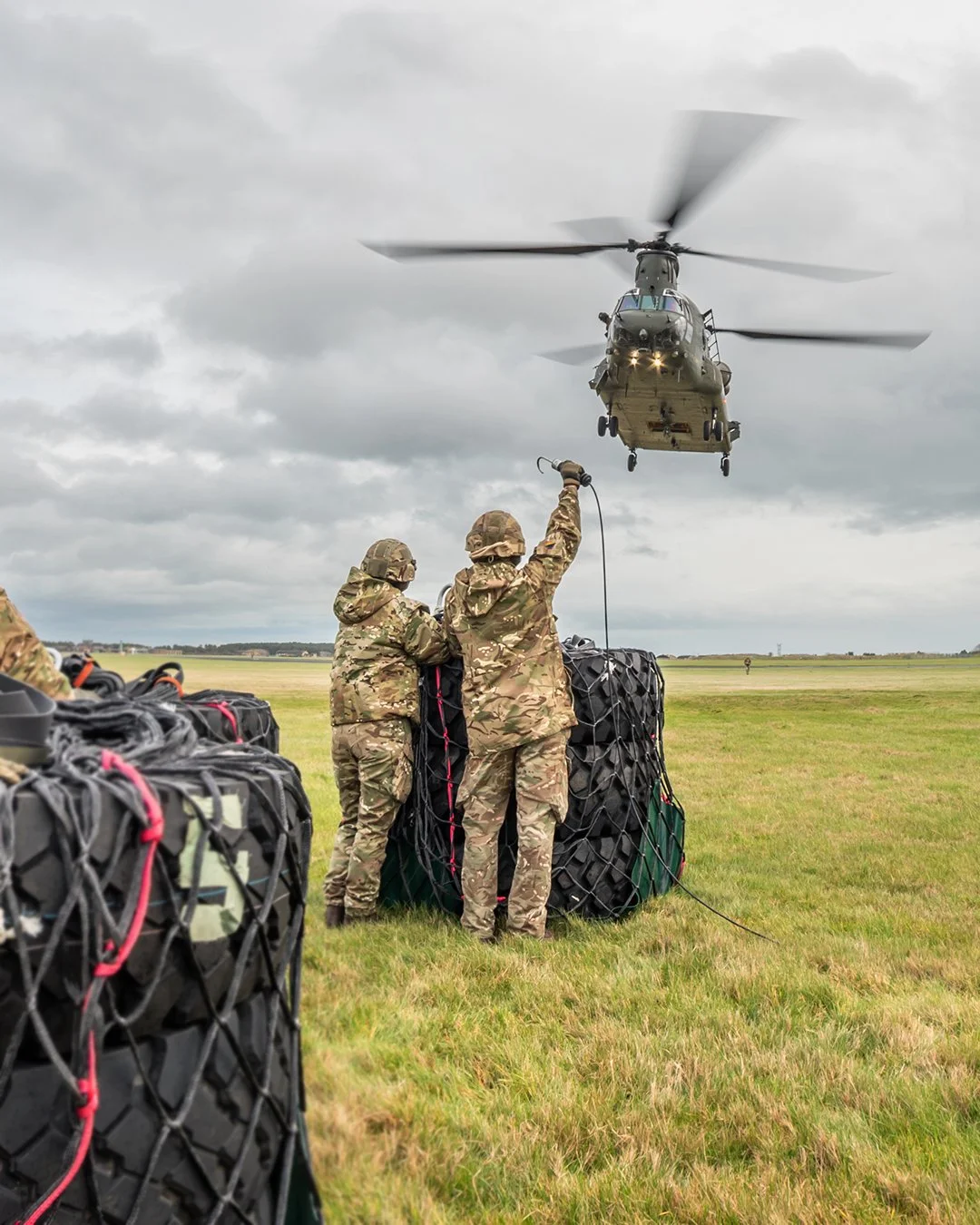
Rigger Marshallers – Responsible for the rigging and preparation of underslung loads, ensuring equipment, vehicles and supplies are correctly configured for safe air movement. Personnel conduct thorough before-use inspections of Helicopter Underslung Load Equipment (HUSLE), confirming all lifting equipment is serviceable and correctly assembled prior to use. Once prepared, teams carry out the hook up of the load to the aircraft, safely attaching the rigged equipment and supplies to the helicopter to enable efficient underslung lift operations.
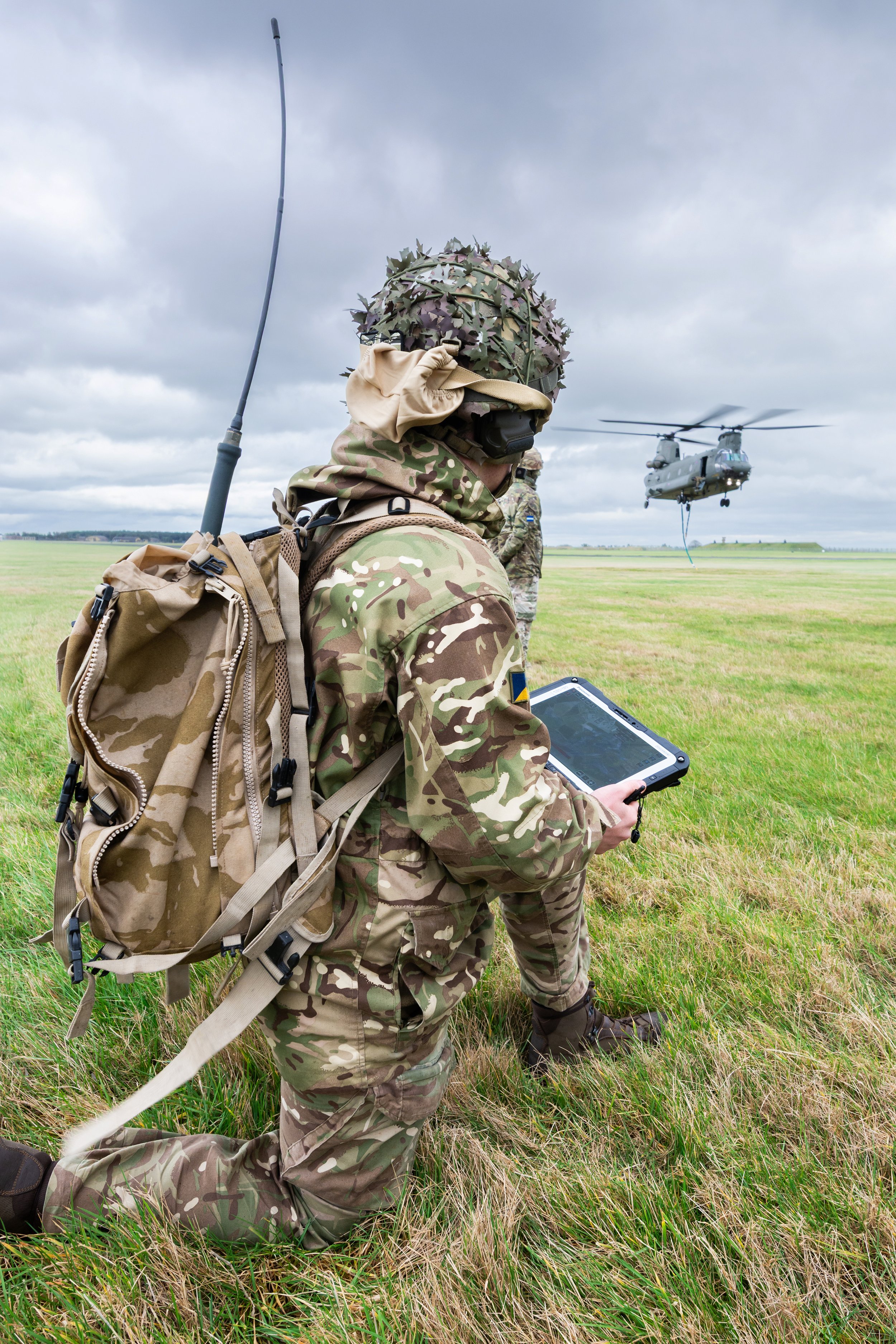
Communications Specialists – Tasked with establishing, operating, and maintaining communications systems that enable safe and effective helicopter operations. They provide reliable voice and data links between landing sites and air assets, setting up and managing tactical radios, satellite communications, and secure voice systems.
Landing Point Commanders (LPCs) – Oversee the establishment and management of landing points and temporary helicopter operating sites. Working closely with Aircrew and Rigger Marshallers, LPCs ultimately supervise all activity at the landing point to ensure the safe and efficient movement of aircraft, additional equipment and personnel.
Together, these teams allow JHSS to deliver rapid, coordinated support, enabling helicopters to operate effectively in challenging operational environments.
“The Squadron is made up of several particularly niche roles.” said Corporal Orde, an experienced team leader at JHSS. “The RAF and Army Air Corps naturally have more of an aviation background prior to joining, however, the Royal Logistics Corps have never been around aviation before, so our first step following recruitment is getting these personnel comfortable and operating safely, instilling the safe approach angles and general safety rules around aircraft.”
Day-to-day Operations
The underslung load technique is a critical skill, enabling helicopters to transport heavy, bulky, or otherwise difficult-to-move cargo to areas inaccessible by conventional vehicles or runways. In combat, it allows rapid support of forward-deployed battle groups and the execution of raids beyond British troop positions. As such, moving artillery and equipment in minutes is a core skill practiced daily at the JHHS base at RAF Benson. The Squadron operates the Benson “load park,” a designated area on the airfield for underslung load training. Equipment such as ISO containers and netted loads are kept ready for use and maintained weekly by on-duty JHSS personnel. Squadrons at Benson can reserve the load park through a booking system, specifying the sortie duration and type of equipment required. JHSS in turn handles the rigging and hook-up operations to support the training needs of other squadrons.
Home to 28 Army Cooperation Squadron, the Chinook Operational Conversion Unit (OCU), RAF Benson’s load park is ideally located to support frequent OCU training. Frontline Chinook squadrons also receive similar support through a load park at RAF Odiham. The repeated training builds confidence for both sides of the headset, while strong ground-to-air communication, disciplined drills, and consistent turnarounds ensure the underslung load capability remains reliable, ready, and fully mission-capable.
Alongside the load parks, JHSS holds a standby role to deliver assistance through the Military Assistance to Civilian Authorities (MACA) provision. The requirement specifies U.K. Armed Forces providing support to civilian organisations, typically government departments, local authorities, or emergency services, when those civilian authorities are overwhelmed or require capabilities that they cannot provide themselves. JHSS maintains a team on standby to help if they are called upon, which would typically be in an unforeseen event such as severe flooding.
The squadron last responded to a MACA call in 2019, when extreme rainfall caused a partial collapse of the Toddbrook Reservoir dam in Derbyshire. The damage posed an immediate risk to the nearby village of Whaley Bridge, where thousands of residents faced potential flooding. To prevent catastrophic failure, a Chinook from RAF Benson was tasked with delivering one-tonne bags of aggregate directly onto the compromised section of the dam wall, a precision operation requiring careful coordination to avoid further destabilisation.
JHSS personnel deployed alongside the Chinook force to manage the underslung hook-up of over 400 tonnes of aggregate. Their expertise ensured safe and efficient rigging, allowing each load to be accurately placed under challenging conditions, including high winds and saturated ground. The operation involved multiple sorties, constant ground-to-air communication, and tight coordination with local emergency services and civil engineers overseeing the dam’s integrity.
Through these combined efforts, the dam was stabilised, water levels were managed, and the immediate threat to Whaley Bridge was eliminated. The mission successfully prevented the dam from breaching, demonstrating the Squadron’s capability to execute complex, high-risk MACA tasks under pressure.
Skill Sharing
Operations such as Whaley Bridge illustrate the depth of specialist expertise within the Squadron. That knowledge is not only applied operationally but also passed on across the wider Armed Forces. With decades of experience in developing underslung load techniques and operational expertise, JHSS has become the UK’s premier squadron for aviation lift. To share this knowledge and develop capability across the British Armed Forces, JHSS operates the integrated Defence School of Helicopter Handling at RAF Benson.
The school serves as the centre of excellence for helicopter handling across Defence and has developed seven uniquely different courses that range from basic awareness of rotary air movement and helicopter landing sites to advanced instruction and the management of multiple landing point teams in an operational environment. Despite having a relatively small team made up of a mixture of Army and RAF Senior Non-Commissioned Officers (SNCOs), led by an RAF training officer, the staff are highly skilled and deliver first-class training across Defence in a multi-domain environment. The team is often supported by the wider Squadron, enabling an unmatched training output that is unique to JHSS and the school.
The primary courses delivered, progressing from the most basic to the most advanced, include the Helicopter Familiarisation Course, Helicopter Landing Site Custodian, Rigger Marshaler, Landing Point Commander, Helicopter Load Slinging Equipment Inspector, Helicopter Landing Site Manager, and Helicopter Handling Instructor. In addition to these, the school also delivers Human Factors Foundation and Continuation courses.
The school is also home to the Squadron’s Training Cell, consisting of two Senior SNCOs who support all of the Squadron’s training requirements, ranging from career courses to individual training, as well as the planning and execution of the annual Training Level Echo exercise known as Hookers Cyclone, which integrates both Squadron assets, reserve forces, and aviation assets from across the Joint Aviation Command.
Global Reach
From equatorial jungle to Arctic snowfields, the Joint Helicopter Support Squadron operates wherever U.K. rotary power deploys. As a highly specialised enabler of underslung load operations, the Squadron is rarely absent when Joint Aviation Command sends helicopter detachments across the globe - Deployment readiness is not a slogan within JHSS; it is a constant state. Beyond the daily tempo of the load parks at RAF Benson and RAF Odiham, the unit’s calendar is packed with exercises and detachments that deliberately push personnel out of routine and into demanding environments.
In the southern hemisphere, the unit provides personnel to assist with passenger handling in the Falkland Islands, where they support Bristow-operated S-92 helicopter operations based at RAF Mount Pleasant. They primarily assist with the movement of military personnel, equipment and supplies across the windswept archipelago, which Bristow facilitates under contract to the U.K. Ministry of Defence (MOD).
Along the equator, JHSS has regularly supported U.K. rotary-wing operations deep inside the rainforests of Brunei. The tropical climate tests the endurance of crews, operating in the high humidity and heat and confined clearings, primarily in conjunction with the British Army presence in the region and jungle warfare training being conducted there.
In the far north, the Squadron provides support during Exercise Clockwork, where aircrew and ground-based personnel train in Norwegian Arctic and sub-Arctic conditions running underslung load serials alongside the Chinook and Merlin Forces, the Commando MAOT and NATO partners. The cold weather changes how loads behave in flight and how equipment performs. Metal components become brittle, hydraulic systems respond differently, and snow and rotor wash can create severe white-out conditions. JHSS adapts their drills accordingly to maintain safety and precision.
Closer to home, the Squadron supports the Chinook Operational Conversion Unit during demanding UK-based detachments. These exercises culminate in high-pressure final assessments that clear students for frontline squadrons. One such deployment, Exercise Kukri Dawn, sees the OCU leave RAF Benson several times each year to operate from unfamiliar locations, testing crews in new terrain and conditions. In February and March 2026, the exercise deployed to Leuchars Station on Scotland’s east coast - where the author joined the unit to gain an inside look at their world of logistics, coordination and aviation precision.
Stood on a remote site along the Fife coast, a JHSS communications specialist scans the assigned frequencies, toughbook tablet in hand, monitoring the topographic display for the tell-tale tracking signature of an inbound Chinook. To their right, soldiers from 2 Close Support Battalion REME work methodically on an unserviceable Land Rover Defender 4x4, awaiting spares packed inside an ISO container already rigged for underslung delivery from Leuchars Station.
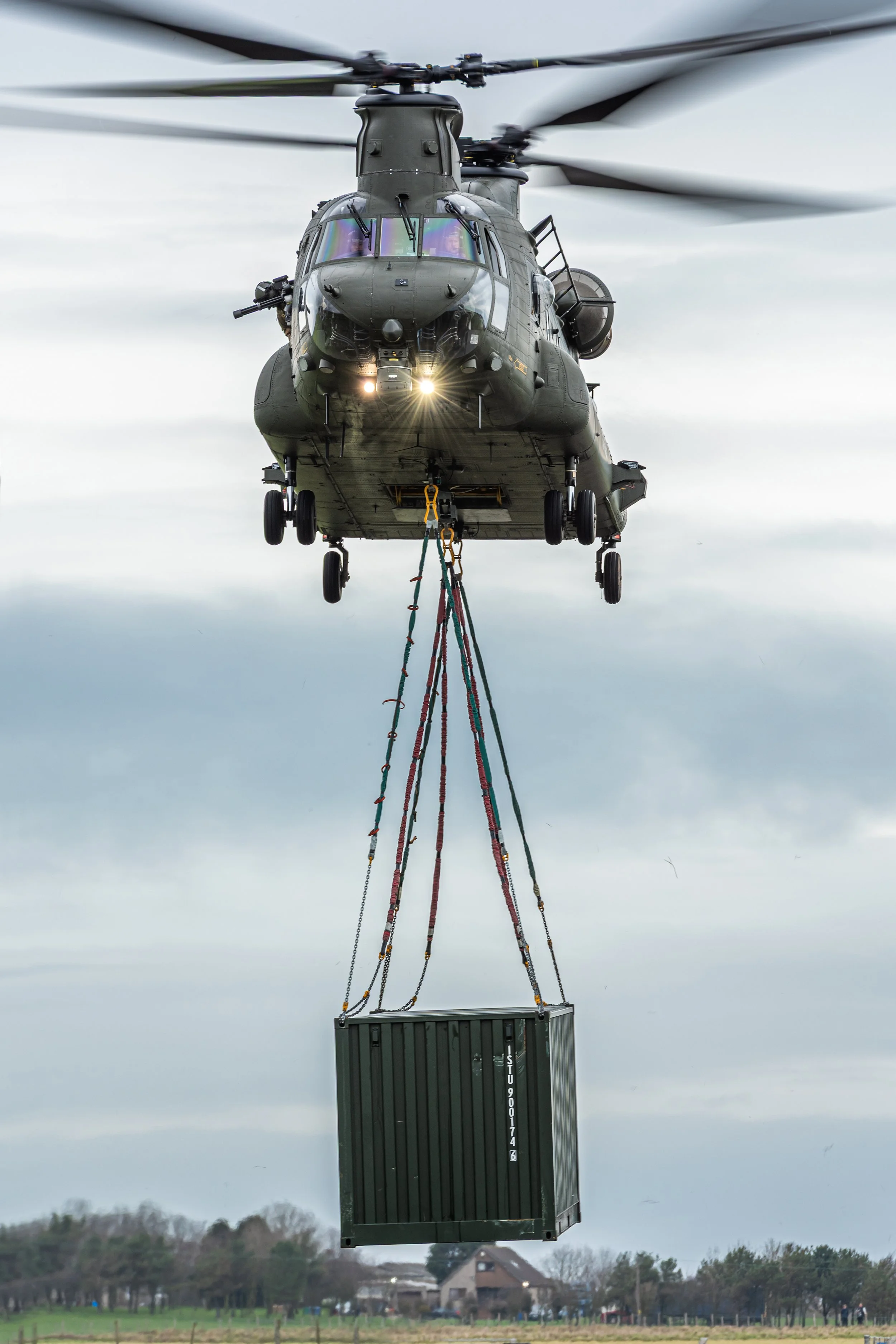
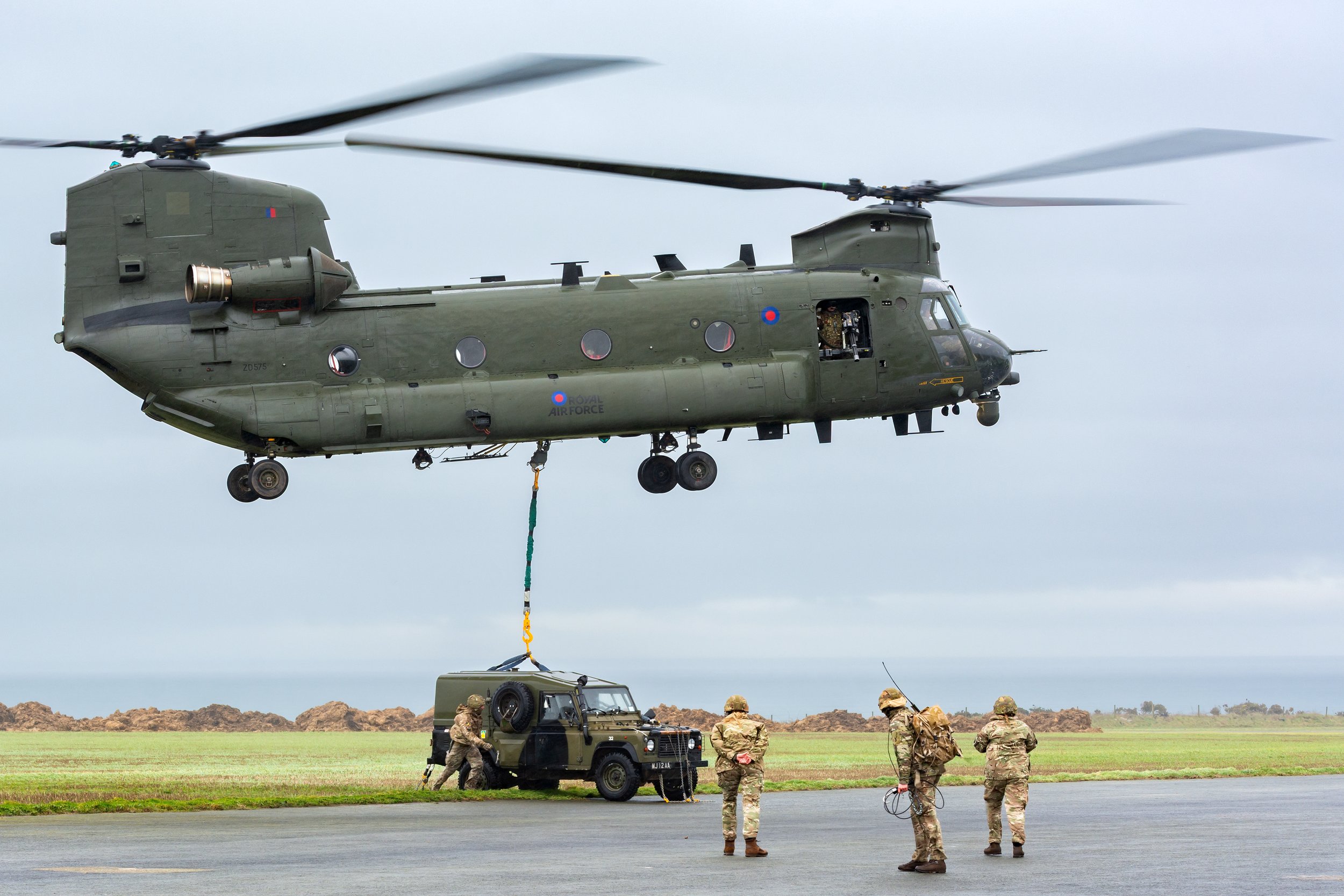
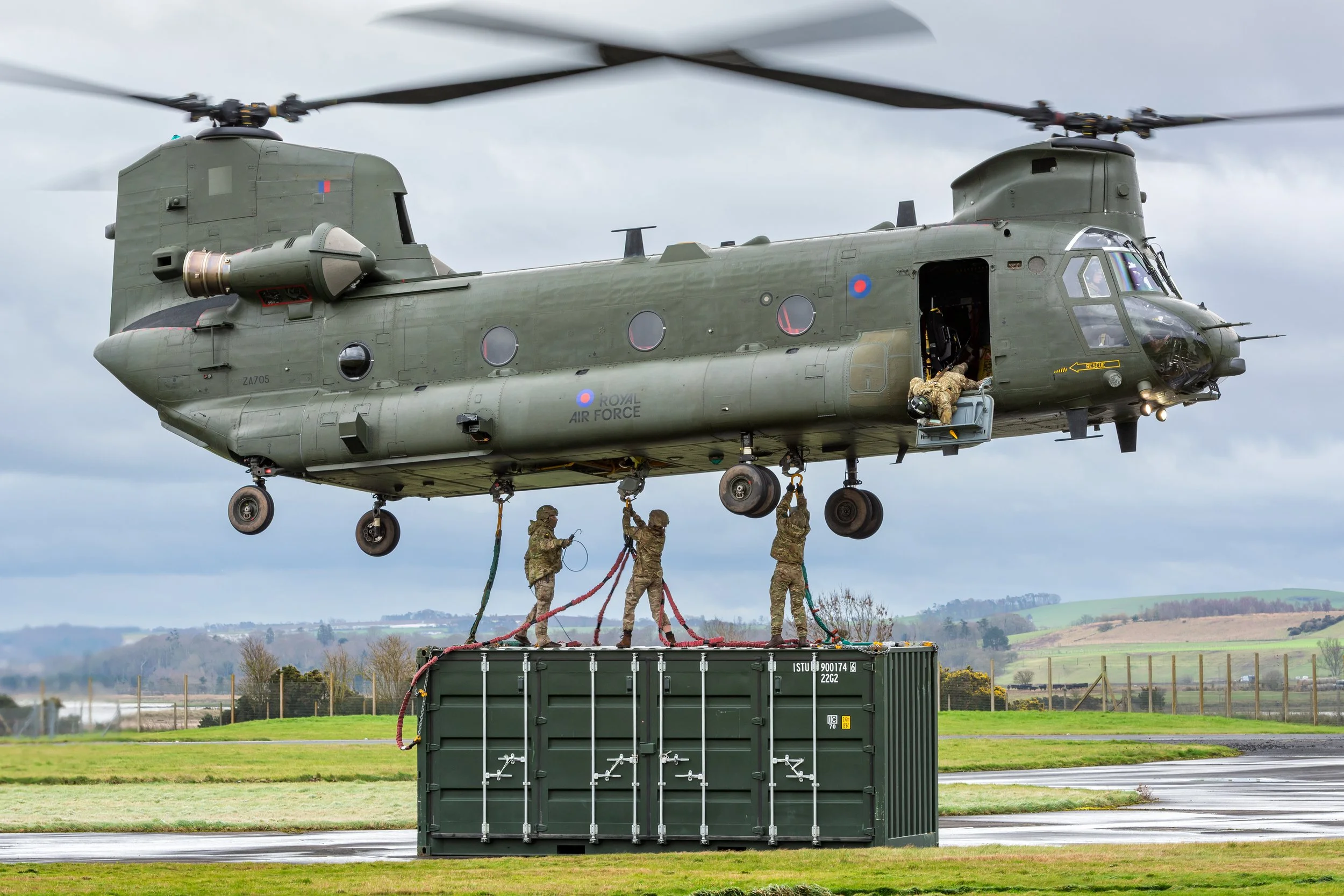
The JHSS team has cleared and surveyed the landing site, removing debris and identifying surface hazards that could become dangerous projectiles under rotor wash. The Chinook announces its arrival long before it appears, the distinctive beat of its rotors carrying through the murk as it approaches at low level. With controlled precision, the crew positions the aircraft into the hover and lowers the ISO container onto the tarmac, releasing the sling before climbing away.
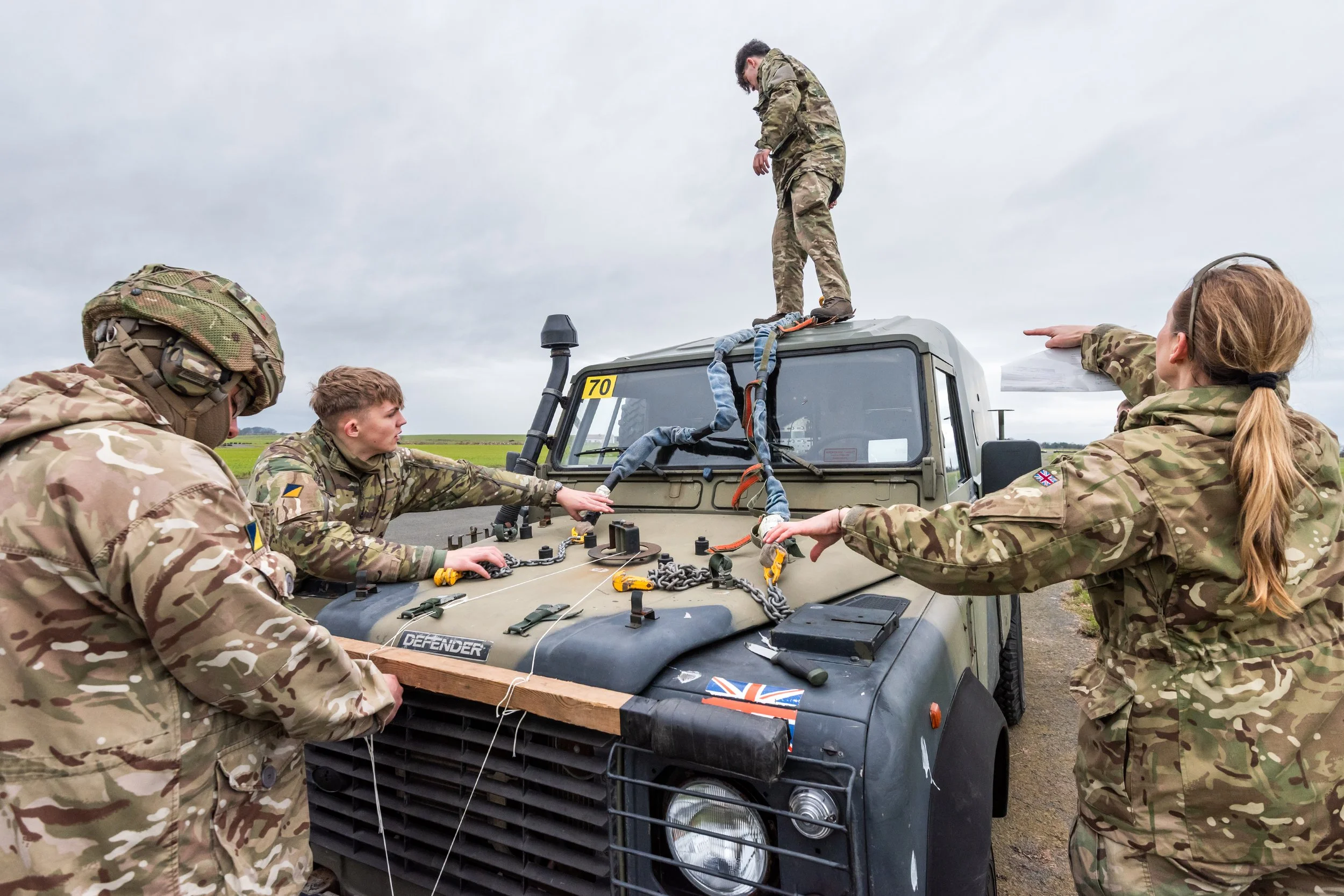
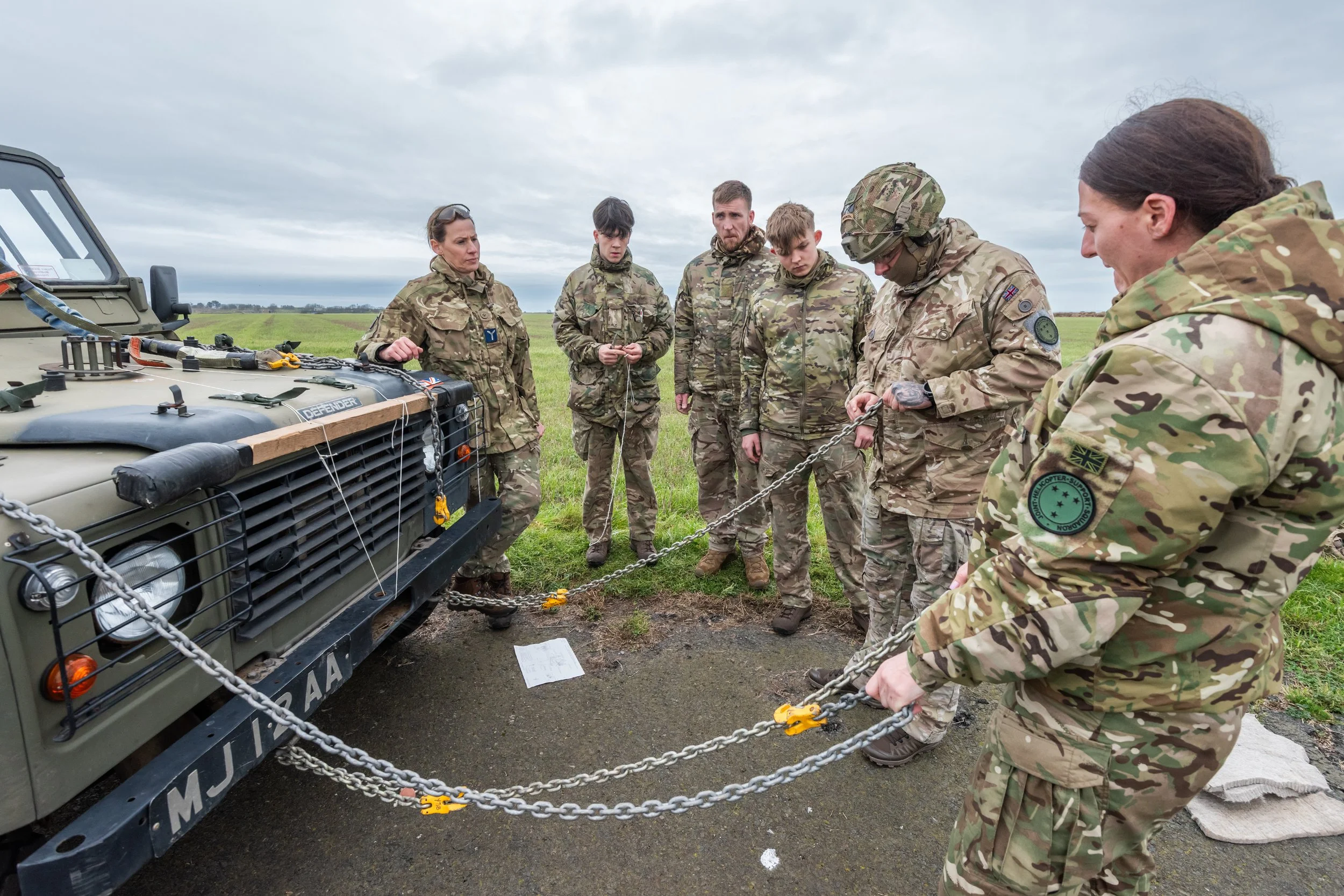
The exercise scenario dictates that the Defender cannot be repaired in situ. Two aircraft are now tasked to recover both the container and the vehicle simultaneously — a coordinated dual lift in marginal weather. While the ISO container presents a straightforward lift using its integral corner fittings, the Defender requires a bespoke rigging scheme.
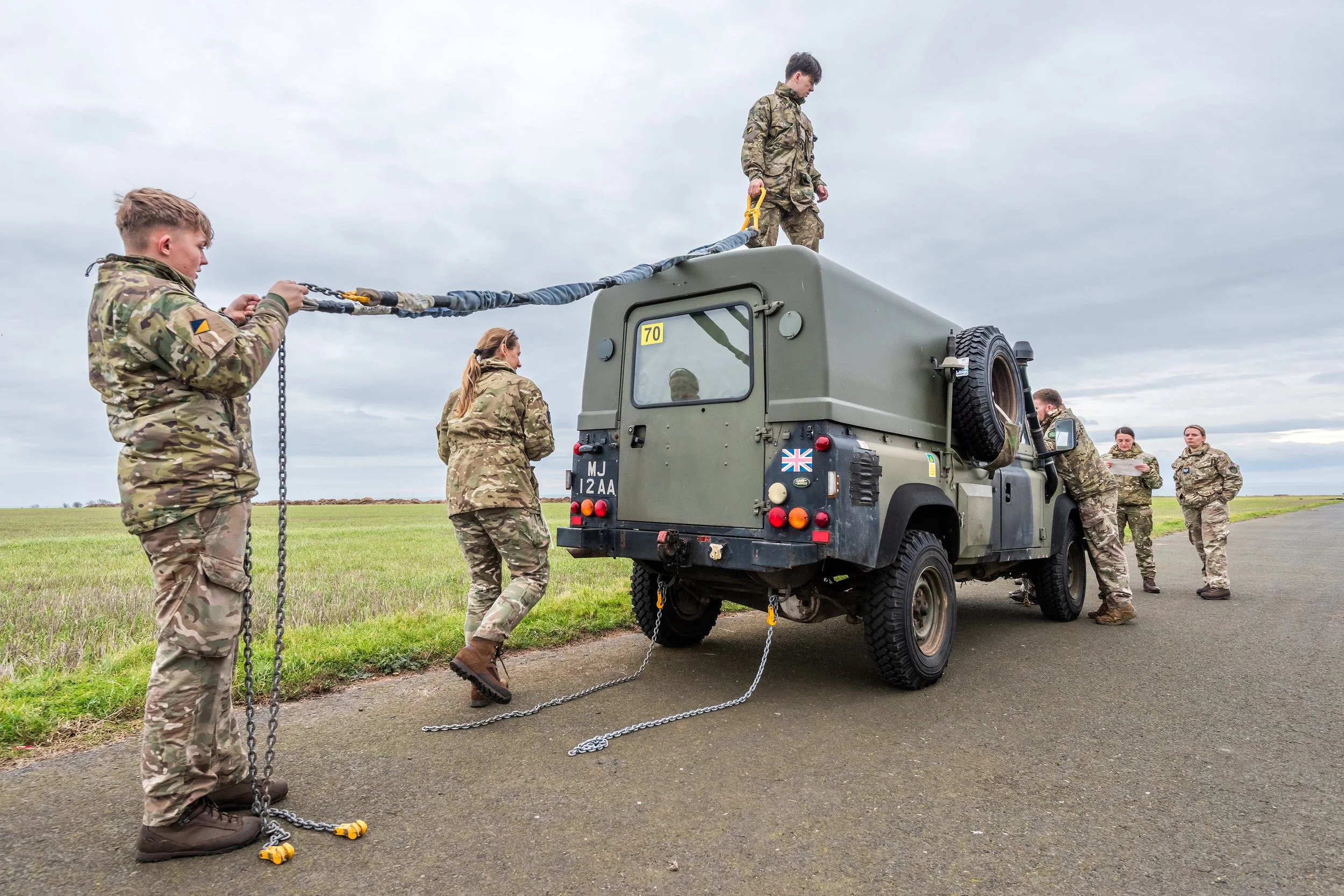
Landing Point Commander, Air Specialist (Class 1) Jackson outlines the priorities:
“The most important factor in these scenarios is safety. I ensure the chains have been correctly assembled and secured by the rigger marshallers and confirm anything loose or movable has been properly restrained. Items such as fuel caps and wipers are taped down to prevent movement in flight. It’s critical that the equipment arrives fully serviceable.”
Each load is prepared in accordance with established, trialled lifting schemes, supported by detailed diagrams specifying exact chain configurations and link counts. These procedures are designed not only for balance and structural integrity, but to mitigate risk during the critical transition from ground to hover.
“We’ve rigged this vehicle in calm conditions,” Jackson continues, “but once the aircraft comes into the hover, rotor wash will cause the chains to move. If uncontrolled, that can lead to tangling or compromise the rig. To counter this we use break-string ties to hold sections in place during the hover phase. As the aircraft lifts, the string parts cleanly, allowing the chains to settle correctly under load.”
By the time the two 28 Squadron Chinooks — call signs Samurai 1 and 2 — arrive overhead, both loads are prepared and inspected. JHSS divides into two teams, moving beneath the hovering aircraft to complete the hook-up. Moments later, each air crew receives the final visual confirmation from JHSS that the hook up is complete. The loads lift cleanly through the rain, stabilise, and depart for Leuchars in close succession.
For JHSS, it is another controlled evolution executed to standard: assured rigging, disciplined communication, and seamless coordination enabling rotary lift to operate exactly as intended.
Conclusion
“As a specialist force, there’s limited information about the squadron available online.” Orde explained. “Most personnel join after hearing about opportunities through word of mouth — either by coming across a job listing or through someone they know who has served in the Squadron and shared their positive experiences.
Working in close-knit teams allows us to build strong relationships and understand each other’s strengths and areas for development. We actively create opportunities for growth, ensuring everyone can reach their full potential. Overall, those who serve in the Squadron leave with a lasting impression and a deep appreciation for what we accomplish together every day.”
In an age where advanced avionics and frontline platforms often dominate the headlines, it is easy to overlook the quiet precision that underpins every successful sortie. Yet without the meticulous rigging, assured communications and calm leadership delivered by the Joint Helicopter Support Squadron, some operations could be put in jeopardy due to risk and uncertainty. Whether stabilising a dam in Derbyshire, sustaining operations in jungle or Arctic extremes, or supporting student crews in the Scottish rain, JHSS embodies the simple truth captured in its ethos: together, they deliver. Not for recognition, but to ensure that wherever UK rotary power is called upon, it can arrive, operate and return safely - every time.